
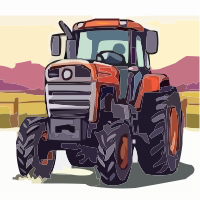
Cabs Commonly Fitted to David Brown Tractors.
Note – this article is only relevant to tractors supplied within the U.K. although some cabs mentioned may have been fitted to exports.
Broadly speaking, tractor cabs fall into three categories;
Weather cabs just protected the driver from the elements to a varying degree. Many were simply a light metal frame supporting canvas, the only glass being in the doors and the windscreen. Others were of metal and/or fibreglass construction.
Safety cabs became a legal requirement on new tractors in September 1970 due to the number of accidents involving overturning tractors. They provided a strong framework to protect the driver from being crushed in the event of the tractor turning over. Cab manufacturers had to supply a sample for testing before they could go into production. Such cabs will carry an approval plate, listing the tractor make and model(s) that it can legally be fitted to.
“Q” cabs became a legal requirement on tractors in June 1976. The noise level had been a problem on virtually all makes of tractor when fitted with a safety cab, as the framework transmitted noise into the cab. Therefore, the next stage was a mandatory maximum noise level, measured at the driver’s ear. To comply with this, it was generally necessary to build the whole cab as a separate unit, complete with a floor, and fit it to the tractor on rubber mountings. Noise transmission could be further reduced by modifying control connections, so hydrostatic steering, together with hydraulic clutch and brake operation was introduced by some manufacturers, their flexible hose carried less noise than ridged metal connections.
From 1977, agricultural tractors built before this legislation came into force had to be fitted with at least a roll-over bar; a stout post on each side of the driver, joined across the top rather like a goalpost. These also had to be tested and carry an approval plate. Owner-drivers who didn’t employ anyone else were exempt from these regulations until 2002. Tractors used only in low buildings or under fruit trees always were and remain exempt. In more recent times, the introduction of much quieter diesel engines enables small, basic tractors to meet current noise limits with just an approved roll bar.
So, what did David Brown do?
Weather cabs were offered as far back as the late 1940’s by David Brown. They promoted a cab made by Portland Engineering; Scottish Aviation offered a similar cab. Both were of metal construction with an open back. From the mid 1950’s to the early 1970’s a metal cab made by Sta-Dri of Bristol was offered. During the 1960’s, a safety frame which fitted inside this cab was offered, prior to becoming a legal requirement. However, the Lambourn cab was the most popular during the 1960’s until the introduction of safety cabs; being clad in canvas, it was the quietest, as well as being less expensive.

Safety cabs - Sta-Dri remained as the approved supplier to David Brown at this stage, though the new cab was totally different to their earlier cabs. It was soon found that the heavy framework increased the noise level inside the cab to an unacceptable level; the interim answer was to replace the steel roof and glass side windows with flexible cladding as an option. Commonly fitted to late 770, 780, 880, 990 and 1200 Selectamatics, also early 995’s, 1212’s and a handful of early 885’s.


A couple of years later, David Brown replaced the Sta-Dri cab with a unit of their own design, named the “Weatherframe”. The rather tall frame with a roof were fitted at the Meltham factory. Optional cladding, either rigid or flexible, was suppled to dealers for fitting, if required; the regulations could be met with any of these options, should the customer choose. Unfortunately, these cab kits gained much criticism for their narrow doors, and anything more than the basic frame and roof added to the noise level. Commonly fitted to the 885, 990 (with Synchromesh gearbox), 995, 996, 1210, 1212, 1410 and 1412.


The first “Q” cab resembled the Weatherframe, though the soundproofed floor raised the driving position and controls. The gear levers were relocated to either side of the cab. The rear of the cab had only flexible cladding as standard, though a sliding glass window became available later. The narrow doors remained a source of criticism. Commonly fitted to the 885, 990 (with Synchromesh gearbox), 995, 996, 1210, 1212, 1410 and 1412.

The Wide Door "Q” cab - David Brown eventually took note and widened the doors. From the top of the mudguards down, the cab remained the same, but the rear edges of the doors from mudguards upwards were moved to a vertical position; this gave more shoulder room though the lower half remained cramped. The rear of the cab was also made more upright too. Here, a sliding glass window became a standard fitment. Commonly fitted to the 885, 990 (with Synchromesh gearbox), 995, 996, 1210, 1212, 1410 and 1412.

The De-Luxe cab - in Scandinavian countries, there was similar “Q” cab legislation, but as farmers had become accustomed to taking short cuts across frozen lakes in the winter, they had a problem with drowning if the ice gave way! This led to the mandatory inclusion of an escape hatch in the roof. As an important export market for David Brown, they needed to comply with this. The diagonal roof bracing in their existing cab precluded fitting a hatch. The answer was to buy in a cab already fitted with a hatch from Sekura. When UK customers became aware of this cab they wanted it too. It was much more modern, with bigger doors, much better vision and a flat floor. Commonly fitted to the 990 (with Synchromesh gearbox), 995, 996, 1210, 1212, 1410 and 1412, but NOT the 885 in the UK.

There were also complaints about the height of all three cabs mentioned above, as competitors had begun offering lower versions on their smaller tractors. Because Sekura already supplied some of these lower cabs, it was a natural next step to offer one for the smaller David Brown models. Unlike other “Q” cabs, which had side-mounted gear levers, this lower cab required a return to centre-mounted gear levers, as used on David Browns before the “Q” cab era. Only fitted to the 885, 990 (with Synchromesh gearbox), 995, 996.

90 Series tractors – introduced in late 1979, were, in the UK, supplied with one basic style of cab, the Sekura S80. This was a more rounded cab in appearance, with door hinged at the rear. Together with the cab being positioned further forward on the cab, this provided much improved access. There are 3 minor variations.
The smaller tractors were fitted with a cab that had a raised section in the front section of the floor. This enabled the cab to sit lower on the tractor. A lower profile roof was also an option, though these are rare. Note that the outer, vertical edges of the mudguards vary in depth, there are two sizes of decals to go here. Fitted to the 1190, 1290 and 1390.
The larger tractors had a completely flat front floor section. Fitted to the early 1490 and 1690.

Late large tractors were the same as the above, but the right hand hydraulic and PTO controls were relocated into a flat topped console. Fitted to the late 1490 and 1690 Turbo.

94 Series tractors used an improved version of the 90 series cab. The right hand console was adopted across the whole range. External grab handles were fitted to the cab front corner posts. The steering orbital unit was relocated under the cab floor to reduce noise and heat. The cab air intake was relocated to draw in cooler air. Most of the interior colour was changed from black to grey.
The smaller tractors had a raised centre to the front floor section. Fitted to the 1194, 1294 and 1394.
The larger tractors had a flat front floor section. Fitted to the 1494, 1594 and 1694.


Comments