
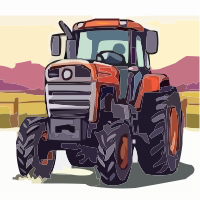
Converting early 3 ½ inch bore diesel engines to 3 5/8 inch bore

Most early 4 cylinder David Brown diesel engines used a 3 5/8 inch bore, the exceptions to this being early Cropmaster Diesels, 25D’s and 850’s.
Consequently, new 3 ½ inch pistons were discontinued many years ago and they have never since been manufactured; if new pistons are needed, the standard procedure, as advised by David Brown, was to convert the engine to 3 5/8 inch bore. The appropriate pistons, complete with rings, can be found on our website, part number E3922.

When carrying out this conversion, it must be noted that the outside diameter of the liners at the bottom was changed several times, regardless of the type of fuel the engine ran on.
Early Cropmaster Diesel.
Until around 1950, the outside diameter at the bottom of the liner was exactly 4 inches. When rebuilding one of these engines there is a particular problem in that a 3 5/8 inch bore would result in the liner walls at the bottom being too thin. The only solution to this problem is to get an engine machine shop to increase the diameter of the holes in the bottom of the block to accept later liners. The best liner to use is part number 902001; the outside diameter at the bottom is 4.075 inches, so a minimal amount if metal needs to be bored out of the engine block.

Early 25D’s.
In the early 1950’s the outside diameter of the liner bottoms was increased to 4 1/8 inches to accommodate 3 5/8 inch bore liners; part number 900132 were used in both the Super Cropmaster (TVO) and the Cropmaster Diesel. To enable the same block to be used on all four cylinder engines, suitable 3 ½” liners, part number 900131 were introduced. Therefore, the conversion involves fitting 900132 liners together with new E3922 piston assemblies.

Late 25D’s and all 850’s
The bottom outside diameter of the liners was reduced to 4.075 inches. This was an attempt to reduce the likelihood of the block cracking between the liners. Liner wall strength was maintained by using thinner liner seals, so reducing the depth of the grooves required to accommodate them. Again, as with the early 25D, this is a straight swap, this time between the 3 ½” liner, part number 900084 and the 3 5/8 inch version, part number 902001

Notes –
The liner part numbers quoted are for the ridged top face type. The ridge was introduced to improve sealing to the head gasket. They are a direct replacement for the earlier, flat faced type, which are no longer available. Having this ridge means that the flat part of this surface should be 3 to 5 thou. inch above the top of the engine block, as opposed to 5 to 8 thou. inch for flat faced liners.
In all cases, a 3 5/8 inch head gasket, part number 901914 should be used. Originally, the larger bore engines would have received slightly more fuel. There is no need to change the fuelling, unless the injector pump is to be rebuilt anyway.

Don’t order new liners until the old ones have been removed and measured; many early David Browns have had the cylinder block changed due to cracking; the engine block you have may be different to the one originally fitted.
Removing old wet liners in any early David Brown engine can cause cracking between cylinders 1 and 2, also 3 and 4, even if there are no existing cracks. After removing the cylinder head, it helps to fill the water jacket with diesel or paraffin and leaving it to soak for a few days.
The AD4/47 engine, as fitted to all 990 Implematics and early 990 Selectamatics retained the 3 5/8 inch bore size and has wet liners, but had a longer stroke. Consequently, the liners are longer, and nothing is interchangeable with earlier engines.


Comments